活動不只是熱鬧:以行為改變視角設計服務More Than a Lively Event: Designing Services Through a Behaviour-Change Lens
2025.05.01・5 分鐘閱讀5 min read
活動作為行為改變的策略手段Events as a strategy for behaviour change
活動是現代社會中重要的互動形式,是人與人之間、人與環境之間發生互動關係的重要媒介。無論企業、組織或個人,都可透過策劃活動達成不同目標──企業凝聚向心力、組織傳遞知識或是個人拉近親密關係。換句話說,活動不僅僅是聚集人群或促進交流的手段,更可以被視為一種行為改變的介入方式。參加者在體驗過程中逐步促進認知轉變、情感投入與行為實踐,最終實現活動所設定的行為改變目標。因此,活動作為一種策略手段,展現了情境營造與行為引導功能,成為現代社會中不可忽視的重要力量。
Events are a key form of interaction in modern society — a medium through which people connect with each other and with their surroundings.Companies, organisations and individuals all use events to reach different goals: building cohesion, sharing knowledge or bringing people closer.In other words, an event is more than a way to gather people; it can be seen as an intervention for behaviour change.Through the experience, participants gradually shift their understanding, invest emotionally and put new behaviours into practice, reaching the change the event set out to achieve.As a strategy, events shape context and guide behaviour, making them a force not to be overlooked.
每一場活動本質上都是一個服務設計,若活動的最終目的是為了達成目標改變目標受眾的行動,那麼作為服務設計師應該要特別關注於五個核心問題:
Every event is, at heart, a service design. If its ultimate purpose is to change what an audience does, a service designer should focus on five core questions:
- 目標受眾是誰
- 目標受眾的需求為何
- 我們想要達成的目標
- 我們希望改變他們什麼行為
- 為什麼他們需要改變
- Who is the audience?
- What does the audience need?
- What do we want to achieve?
- What behaviour do we want to change?
- Why do they need to change?
案例背景:夏耙文蛤|耙一條長長的河口記憶Case: Summer Clam Raking — Memories of the Tamsui River Mouth
我們在2021年以「地方職人資料庫:打造淡水地方平台」為題,申請新北市文化局青年參與社區營造計畫,期待透過服務設計,與地方職人共創,打造9場高品質的文化體驗,同時培育地方青年成為隨隊夥伴,共同建構淡水的友善文化環境,製作Casual Tamsuim原型平台,提高參加者對淡水文化的理解並獲得休憩娛樂價值。透過市場反應,我們發現其中一場體驗「夏耙文蛤|耙一條長長的河口記憶」(以下簡稱夏耙文蛤)受到熱烈的反應,因此,我們根據體驗者的回饋進行服務再設計,2年內舉辦14場次體驗,參與人數為277人,活動經濟效益為65萬元。
In 2021 we applied for New Taipei’s youth community-building grant with “Building a Database of Local Artisans: a Platform for Tamsui,” aiming to co-create nine high-quality cultural experiences with local artisans through service design, train local youth as field companions, build a friendly cultural environment in Tamsui, and prototype the Casual Tamsui platform — helping participants understand Tamsui’s culture while enjoying their leisure time.The market response showed one experience, “Summer Clam Raking — Memories of the Tamsui River Mouth,” was especially popular, so we redesigned the service based on participant feedback.Over two years it ran 14 sessions for 277 participants and generated NT$650K in economic value.
然而,看似叫好又叫座的「夏耙文蛤」體驗,在我前往澳洲研讀創新創業管理碩士後,產生了新的啟發。以往,透過服務設計的視角,我們深入挖掘目標受眾的需求,連結我們想傳遞的目標,並打造服務設計的「甜蜜點」。但那段期間,我接觸到 Prochaska & DiClemente(1983)的行為改變理論(Stage of Change, SOC)與French(2011)提出四種行為交流方式(Four Forms of Exchange),透過專案實練,我深刻領悟到:設計一場好的活動固然重要,但真正的挑戰在於如何改變參加者的行為,進而達到目標。因此,我藉由「行為改變」視角重新審視夏耙文蛤的設計。
Yet this seemingly successful experience took on new meaning after I went to Australia for my master’s in innovation and entrepreneurship.Through service design, we used to dig into the audience’s needs, connect them with the message we wanted to share and find the design’s sweet spot.But there I encountered Prochaska and DiClemente’s (1983) Stages of Change model and French’s (2011) Four Forms of Exchange, and through hands-on projects I realised: designing a good event matters, but the real challenge is changing participants’ behaviour to reach the goal.So I revisited the clam-raking design through a behaviour-change lens.
夏耙文蛤的服務設計:淡水人的人物誌Service design for clam raking: a persona of Tamsui locals
服務設計的本質就是進行一場系統性研究,從研究調查、解讀資料再到產生洞見並設計。設計師往往需要透過多元方法,觀察、訪談、體驗、問卷、口述歷史、文獻、焦點訪談以及其他二手資料的搜集活動設計的素材,並據此建立目標受眾的人物誌(Persona)。人物誌是以使用者為中心,背後代表的是一群具有共同特徵的目標族群,建立主要有兩個目的:
Service design is essentially systematic research — from investigation and interpreting data to generating insights and designing.Designers use many methods — observation, interviews, hands-on experience, surveys, oral history, literature, focus groups and other secondary sources — to gather material, then build personas of the audience.A persona is user-centred and represents a group with shared traits. It serves two purposes:
- 好溝通,讓團隊內部對於使用者的輪廓有共識
- 好設計,透過挖掘使用者的目標、挑戰以及行為區隔等來進行需求導向度設計
- Easier communication: the team shares a common picture of the user
- Better design: needs-driven design based on users’ goals, challenges and behavioural segments
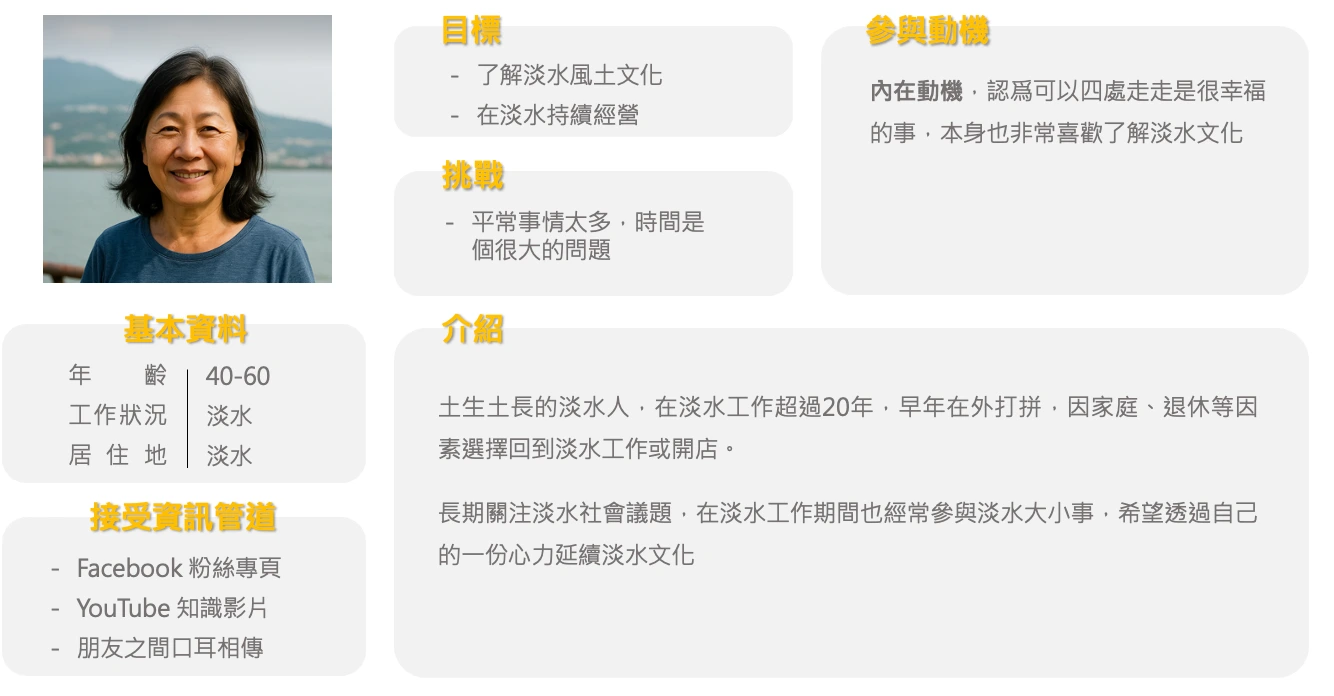
基於訪談、場勘、多方體驗、口述歷史以及文獻資料的研究調查,我們將使用者分為兩類,包含:淡水人以及一般民眾,因為這兩類人對淡水的認知、情感、目標與挑戰大相徑庭。
Based on interviews, site visits, trying many experiences, oral histories and literature, we divided users into two groups — Tamsui locals and the general public — because their knowledge, feelings, goals and challenges around Tamsui differ greatly.
- 淡水人,多已居住40-60年,對淡水文化脈絡掌握度非常高,對於淡水河口生態也是略知一二,他們非常喜歡了解淡水風土文化,只是平常時間忙碌,時間對他們來說是一大挑戰。
- 一般民眾,對於淡水的想像是夕陽、河畔、老街,尤其是台北的民眾,經常在假日與三五好友或是家人臨時決定來到淡水走走,因此無法即時得知有什麼有趣的活動以及可以報名的活動有哪些,他們的行動就會變成是來淡水走走,換句話說,他們並非不願意深度體驗淡水,而是苦無找到體驗的入口。
- Tamsui locals have mostly lived there for 40–60 years. They know its cultural history well and have some sense of the river-mouth ecology. They love learning about Tamsui’s local culture, but they are busy — time is their biggest challenge.
- The general public imagines Tamsui as sunsets, the riverside and the old street.Taipei residents in particular often decide on a whim to visit with friends or family at the weekend, so they can’t easily find interesting activities they could join, and end up simply strolling around.They aren’t unwilling to experience Tamsui in depth — they just can’t find a way in.
雖然本活動的目的最終目的是為了解決一般民眾來淡水休憩痛點,但就短期目標而言,除了讓一般民眾體驗外,活動在策略上更聚焦於淡水人這類族群,這不僅是提升他們對淡水的文化了解,更重要的是改變他們對於我們的認知,來獲得淡水人的認同,同時也更加支持我們的行動,形成更為緊密的人際網絡。
Although the event’s ultimate aim was to solve the general public’s pain point when visiting Tamsui, in the short term it focused strategically on Tamsui locals as well.Beyond deepening their cultural understanding, the goal was to change how they saw us — earning their recognition and support for our work and building a closer network.
結合設計視角:從服務設計到行為改變Combining perspectives: from service design to behaviour change
當設計師已充分理解使用者後,必須進一步思考如何透過活動,讓使用者的行為產生改變,改變什麼以及改變的程度為何?行為改變理論提供重要理解框架,該模型指出個體的行為改變通常會經歷五個階段:前思考期、思考期、準備期、行動期與維持。這意味著,針對不同階段的使用者,應採用不同的介入策略與設計語言,才能有效推動行為轉變。
Once designers fully understand users, they must ask how an event can change users’ behaviour — what to change, and how much.The Stages of Change model offers a key framework: individuals typically move through five stages — precontemplation, contemplation, preparation, action and maintenance.Users at different stages call for different interventions and design language to drive change effectively.
在具體設計策略時,四種交流方式可作為設計者在策略選擇上的參考架構:
When choosing concrete strategies, the Four Forms of Exchange give designers a reference framework built on two axes:
- 「行為決策」(有意識/無意識)
- 「行為動機」(獎勵/懲罰)
- Decision-making (conscious / unconscious)
- Motivation (reward / penalty)
透過此矩陣可區分出四種交流方式:
The matrix yields four forms of exchange:
擁抱(Hug ):主動、有意識地提供正向獎勵,引發參與者內在動機,讓他們自願採取期望行為
Hug: actively and consciously offering positive rewards that spark intrinsic motivation, so participants choose the desired behaviour willingly.
輕推(Nudge):被動、無需深思地設計正向獎勵,通常透過預設選項或默認設置,降低決策成本,自然誘導參與者做出期望行為
Nudge: passively designed positive rewards that need no deliberation — usually defaults or preset options that lower the cost of deciding and naturally steer people toward the desired behaviour.
打擊(Smack):主動、有意識地設置懲罰,當參與者選擇不採取期望行為時,會遭受負面影響或處罰,以此形成動機壓力
Smack: actively and consciously setting penalties, so choosing not to act brings negative consequences — creating motivational pressure.
推撞(Shove):被動、無意識地施加懲罰性約束,透過環境、流程或制度上的強制性限制,迫使參與者朝既定方向行為
Shove: passively imposing punitive constraints through environments, processes or rules that force behaviour in a set direction.
小朋友完成任務即可獲得好寶寶印章Kids earn a gold-star stamp for finishing a task
出席率低於 80% 視為不及格Attendance below 80% means a fail
阿姆斯特丹史基浦機場在小便斗上刻印蒼蠅圖樣,利用視覺焦點引導使用者對準,大幅降低飛濺率Amsterdam Schiphol etched a fly into its urinals — a visual target that sharply cut spillage
公共場所禁煙Smoking bans in public places
結合行為改變理論與交流方式,我們能更清楚掌握使用者的行為轉變歷程與其深度與廣度,並依此設計出更具針對性與效果的活動介入。
Combining the Stages of Change with the forms of exchange, we can better understand the depth and breadth of users’ behaviour change and design more targeted, effective interventions.
走進沙洲的「擁抱式」策略A “hug” strategy: walking onto the sandbar
如上所述,我們應該思考我們希望改變淡水人何種行為?他們為什麼需要改變?淡水人真正的挑戰是如何在繁忙的日常中,願意與我們互動,並提高對我們的認同,從而願意支持我們的行動並參與其中。從行為改變來看,在可觸及的淡水人對我們的態度其實是在於準備期,亦即有意願也願意透過行動支持我們,重點就在於「將意願轉化為實際行動」,因此我們透過挖掘「連在地人都鮮少知道的沙洲文化」,並以有趣的方式轉譯,同時邀請文化講師講進行河口對談。透過這一場「走進沙洲,發現家鄉」的擁抱式策略,淡水人在每一步行動中深化對我們的認同,最終化作主動支持的動力。
So what behaviour did we want to change in Tamsui locals, and why? Their real challenge was finding time, amid busy lives, to engage with us, grow to trust us and then support and join our work.In Stages-of-Change terms, the locals we could reach were in preparation — willing to support us — and the key was turning intention into action.So we uncovered the sandbar culture that even locals rarely knew about, translated it in a fun way, and invited cultural lecturers for a conversation at the river mouth.Through this “walk onto the sandbar, rediscover your hometown” hug strategy, locals grew more connected to us with every step, until that connection became active support.
活動不只是熱鬧,更是一種行為改變的策略手段,服務設計帶領我們設計活動的甜蜜點,然而真正的挑戰在於如何改變參加者的行為。2021年我們設計的夏耙文蛤|耙一條長長的河口記憶活動,叫座的反應已經證實這是一場成功的服務設計,然而透過行為改變視角,我才領悟到——成功不僅是辦得好,更是辦得有意義,唯有在「甜蜜點」之外,思考「行為改變」,活動才能超越瞬間的熱鬧,化為改變的動能,而這也才是活動的真正價值所在。
An event is not just a lively gathering — it is a strategy for behaviour change. Service design helps us find an event’s sweet spot, but the real challenge is changing participants’ behaviour.The strong response to our 2021 clam-raking experience proved it was successful service design, yet the behaviour-change lens taught me that success means not only running an event well, but making it meaningful.Only by thinking beyond the sweet spot to behaviour change can an event move past a moment of excitement and become a force for change — and that is where its true value lies.
參考資料References
French, J. (2011). Why nudging is not enough. Journal of Social Marketing, 1(2), 154–162
Prochaska, J. O., & DiClemente, C. C. (1983). Stages and processes of self-change of smoking: Toward an integrative model of change. Journal of Consulting and Clinical Psychology, 51(3), 390–395.