淺談服務創新的共創設計:從識別利害關係人需求開始Co-Design for Service Innovation: Starting from Stakeholder Needs
2025.04.14・7 分鐘閱讀7 min read
設計一場「好」且「有意義」的淡江75週年路跑活動
Designing a “Good” and “Meaningful” 75th Anniversary Running Event at Tamkang University
在我們的日常生活中,重大活動常被視為一種儀式性的實踐,藉此紀念重要時刻並號召利害關係人共同參與。2025年,正值淡江大學創校75週年,這是一段深具意義的歷史里程碑。其中預計已「校園路跑」作為象徵性行動,邀請所有與淡江有深厚連結校友與夥伴們一同參與、共襄盛舉、共同見證。
In our daily lives, major events are often seen as a form of ritual practice—commemorating important moments and rallying stakeholders to participate together.In 2025, Tamkang University celebrates its 75th anniversary, marking a historically significant milestone.A symbolic campus marathon is planned to invite alumni and partners with deep ties to Tamkang to take part, witness, and celebrate this occasion together.
在規劃這樣的活動時,服務設計(Service Design)提作為一種工具,幫助我們思考如何協助使用者在體驗服務的前中後擁有順暢、高品質且有意義的旅程。於是服務設計者,就必須思考一個問題,如何創造一個「好」且「具有意義」的旅程?
為了回答這個問題,我們必須先理解的是
- 意義是對誰而言?
- 什麼樣的體驗才能被稱為「好」且「具有意義」?
When planning such an event, Service Design can serve as a helpful tool to guide us in creating a smooth, high-quality, and meaningful journey for users before, during, and after their experience.Thus, service designers must ask an essential question: how do we design a journey that is both good and meaningful?
To answer this question, we must first understand: >Meaningful for whom? >What kind of experience can be considered “good” and “meaningful”?
價值共創:從任務了解利害關係人的深層需求
Value Co-Creation: Understanding Stakeholders’ Deep Needs through Their Jobs-to-be-Done
在現今的服務創新中,價值共創(Value Co-Creation, VCC)已經成為組織提供產品或服務的重要創造模式,顧客透過積極的參與互動(Engagement)與組織共創(Prahalad& Ramaswamy, 2004),從顧客角度來看,他們可以為自己完成工作(Job to Be Done, JTBD),另一方面組織也可以提供對的產品或服務。
In today’s service innovation, Value Co-Creation (VCC) has become a key approach for organizations delivering products or services.Through active engagement and co-creation with organizations (Prahalad & Ramaswamy, 2004), customers contribute to achieving their own Jobs-to-be-Done (JTBD)(Christensen, Dillon & Duncan, 2016). .From the customers' perspective, they fulfill their own goals, while the organization provides the right product or service.
然而意義不僅來自顧客的任務完成,方世杰(2024)整理並指出價值共創的參與早已經不侷限於顧客,每一類的利害關係人也是價值共創者(Co-Creator)。這意味著,作為服務設計師,我們的設計思維不應只停留在滿足顧客任務的層次,更應進一步探尋:在這個服務旅程中,不同利害關係人所追求的「任務」與「意義」是什麼?
However, meaning doesn’t only arise from customers achieving their tasks. Fang Shih-Chieh (2024) notes that participants in value co-creation are no longer limited to customers—all types of stakeholders are now considered co-creators of value.This implies that, as service designers, our design thinking should go beyond merely satisfying customer tasks. We must ask: In this service journey, what “jobs” and “meanings” are pursued by different stakeholders?
任務本身就承載著利害關係人對意義的理解與期待,換言之,當我們從「任務」的角度出發去理解利害關係人的行為與需求,我們才能真正打造出一段對所有參與者而言都「好」且「有意義」的服務旅程。
Tasks inherently carry stakeholders’ understanding and expectations of meaning.In other words, when we look at stakeholders’ actions and needs through the lens of their “jobs,” we can truly create a journey that is “good” and “meaningful” for all participants.
活動議題重大性鑑別:讓每一位利害關係人都能完成任務、產生意義、獲得價值
Materiality Analysis: Enabling Stakeholders to Achieve Their Tasks, Create Meaning, and Derive Value
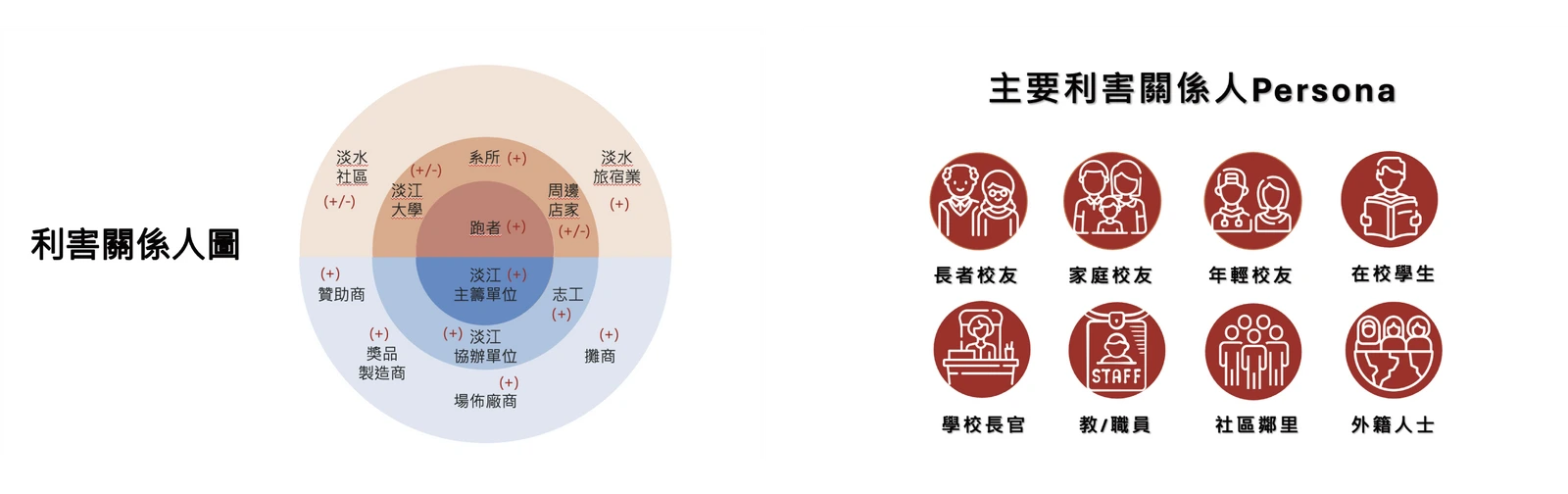
因此,在創造讓利害關係人完成任務、共同創造意義的平台為前提下,我們需要鑑別利害關係人與其需求。透過腦力激盪、關係識別、分群原則、影響力鑑別並排序,我們鑑別出主要8大利害關係人,並以人物誌(Persona)描繪跑者(最主要的利害關係人),共產生8種可能的跑者類型。
To build a platform that allows stakeholders to achieve their goals and co-create meaning, we must first identify stakeholders and their needs.Through brainstorming, relationship mapping, segmentation principles, and influence analysis, we identified 8 primary stakeholder groups and created personas to represent the runners—the key stakeholder group—resulting in 8 possible runner types.
8大類利害關係人:跑者、淡江大學、系所、周邊店家、主辦單位、協辦單位、志工與淡水社區
8種跑者類型:長者校友、家庭校友、年輕校友、在校學生、學校長官、教/職員、社區鄰里與外籍人士
8 Key Stakeholder Groups: Runners, Tamkang University, departments, local businesses, organizers, co-organizers, volunteers, and the Tamsui community.8 Types of Runners: Senior alumni, family alumni, young alumni, current students, university leaders, faculty/staff, neighborhood residents, and international participants.
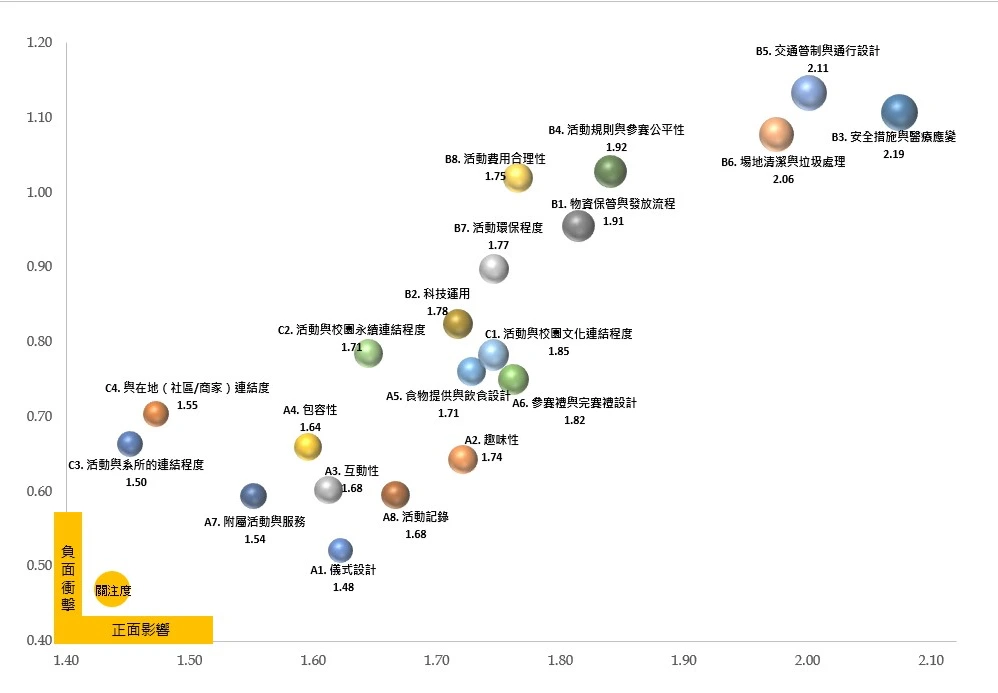
重大性議題分析Activity Materiality Analysis
查看完整數據表(20 項議題)View the data table (20 issues)
| # | 議題Issue | 正面影響Positive | 負面衝擊Negative | 關注度Concern |
|---|---|---|---|---|
| B3 | 安全措施與醫療應變Safety & medical response | 2.07 | 1.11 | 2.19 |
| B5 | 交通管制與通行設計Traffic control & access | 2.00 | 1.13 | 2.11 |
| B6 | 場地清潔與垃圾處理Cleaning & waste | 1.97 | 1.08 | 2.06 |
| B4 | 活動規則與參賽公平性Rules & fairness | 1.84 | 1.03 | 1.92 |
| B1 | 物資保管與發放流程Supplies & distribution | 1.81 | 0.96 | 1.91 |
| C1 | 活動與校園文化連結程度Link to campus culture | 1.75 | 0.78 | 1.85 |
| A6 | 參賽禮與完賽禮設計Race kits & finisher gifts | 1.76 | 0.75 | 1.82 |
| B2 | 科技運用Use of technology | 1.72 | 0.82 | 1.78 |
| B7 | 活動環保程度Environmental footprint | 1.75 | 0.90 | 1.77 |
| B8 | 活動費用合理性Fair pricing | 1.76 | 1.02 | 1.75 |
| A2 | 趣味性Fun | 1.72 | 0.64 | 1.74 |
| A5 | 食物提供與飲食設計Food & drink | 1.73 | 0.76 | 1.71 |
| C2 | 活動與校園永續連結程度Link to campus sustainability | 1.64 | 0.78 | 1.71 |
| A3 | 互動性Interactivity | 1.61 | 0.60 | 1.68 |
| A8 | 活動記錄Event documentation | 1.67 | 0.59 | 1.68 |
| A4 | 包容性Inclusivity | 1.60 | 0.66 | 1.64 |
| C4 | 與在地(社區/商家)連結度Link to local community & shops | 1.47 | 0.70 | 1.55 |
| A7 | 附屬活動與服務Side events & services | 1.55 | 0.59 | 1.54 |
| C3 | 活動與系所的連結程度Link to departments | 1.45 | 0.66 | 1.50 |
| A1 | 儀式設計Ritual design | 1.62 | 0.52 | 1.48 |
針對8大類利害關係人,我們應用全球報告倡議組織(Global Reporting Initiative, GRI)框架,調查利害關係人關注的活動議題以及議題帶來的正負面衝擊影響,調查共20個議活動題,並制定活動重大議題矩陣。首先,我們將活動議題分為三類,包含:活動體驗8項、活動執行與服務8項以及活動與校園及社會連結4項,並在回收問卷後分析活動議題重大性,並對利害關係人的影響力加權。透過調查分析,我們有幾項發現:
For these 8 stakeholder groups, we applied the Global Reporting Initiative (GRI) framework to examine the issues they care about and analyze the positive and negative impacts of these issues.A total of 20 event-related issues were identified, categorized into three themes: 8 for event experience, 8 for event execution and service, and 4 for connection to campus and society.After collecting and analyzing the survey results, we weighted the impact of each stakeholder to produce an event materiality matrix.
第一、針對各項活動議題,利害關係人幾乎都給予高關注度,在3分尺度中,每項活動議題皆介於1.48-2.19之間。
第二、利害關係人更看重活動執行與服務活動議題,前五大活動議題分別為交通管制與通行設計、安全措施與醫療應病、場地清潔與垃圾處理、活動規則與參賽公平性、活動費用合理性,同時關注度也皆為最高,這意味著,相較於活動內容,可以順利、平安完賽是相對重大的議題,因此在活動設計上需更爲小心。
第三、活動體驗活動議題中,科技運用、食物提供與飲食設計、參賽禮與完賽禮設計、物資保管與發放流程以及活動環保度是相對重要的,可以看出與趣味性、互動性與儀式設計,利害關係人更側重於實體價值獲得。
第四、活動與校園及社會連結方面,利害關係人更關注於活動與校園永續以及文化的連結程度,針對與在地連結度以及系所連結度相對關注度比較薄弱。
Key findings include:
High Concern Across the Board: Stakeholders rated nearly all event issues with high concern. On a 3-point scale, issue scores ranged from 1.48 to 2.19.
Execution & Safety Come First: Stakeholders placed the highest priority on event execution and service issues.The top five concerns were traffic control and access design, safety and medical response, cleanliness and waste management, fairness of rules and competition, and reasonable event fees.This indicates that a safe and smooth experience is more critical than event content, requiring extra attention in the design.
Tangible Value Over Symbolic Experience: Among event experience issues, stakeholders prioritized the use of technology, food and beverage design, race kits and finisher gifts, material handling, and environmental sustainability—highlighting a greater concern for tangible benefits than for entertainment, interaction, or ritual elements.
Campus and Social Linkage: Within connection to campus and society, stakeholders valued sustainability and cultural connection over ties to local communities or academic departments.
MVP設計思維:設計一段可實踐、可共感的75週年旅程
MVP Thinking: Designing a Feasible and Empathetic 75th Anniversary Journey
在資源有限的情況下,如何透過了解利害關係人的需求,安排優先順序是在服務設計中不可忽視的關鍵工作。然而,這也並不代表我們只需要專注在某些活動議題上,而是運用這些議題的排序結果,作為設計服務方案的基礎,發展最小可行性產品(Minimum valuable product, MVP),以確保活動能在有限的資源下仍具備完整且有意義的體驗結構。
Given limited resources, prioritizing stakeholder needs is a crucial part of service design. However, this does not mean focusing only on a few issues.Instead, we use the priority matrix as a foundation to develop a Minimum Viable Product (MVP)—a prototype that ensures the event offers a complete and meaningful experience even within constraints.
在多元且複雜的利害關係人情境中,「有意義的服務設計」從來都不是追求滿足所有人的全部需求,而是識別最具共感的價值,為價值而設計。淡江75週年路跑活動的設計,正是一次以利害關係人為核心、以意義為導向的實踐歷程。設計,從理解需求開始;而意義,則在共創中發生。
In a diverse and complex stakeholder environment, meaningful service design is never about fulfilling everyone’s needs completely. It’s about identifying the most empathetic and shared values, and designing for those.The Tamkang University 75th Anniversary Running Event is an example of a stakeholder-centered, meaning-driven design process. Design begins with understanding needs; meaning emerges through co-creation.
參考文獻
Reference
Christensen, C. M., Hall, T., Dillon, K., & Duncan, D. S. (2016). Know your customers’ jobs to be done. Harvard Business Review, 94(9), 54-62.
Prahalad, C. K., & Ramaswamy, V. (2004). The future of competition: Co-creating unique value with customers. Harvard Business Press.
方世杰,2024,廿一世紀的策略新典範:價值共創的理論與實踐。產業與管理論壇,26(3),8-11。