UQ Link App|一站式校園資訊平台UQ Link App: A One-Stop Campus Information Platform
課程專案簡介Course project overview
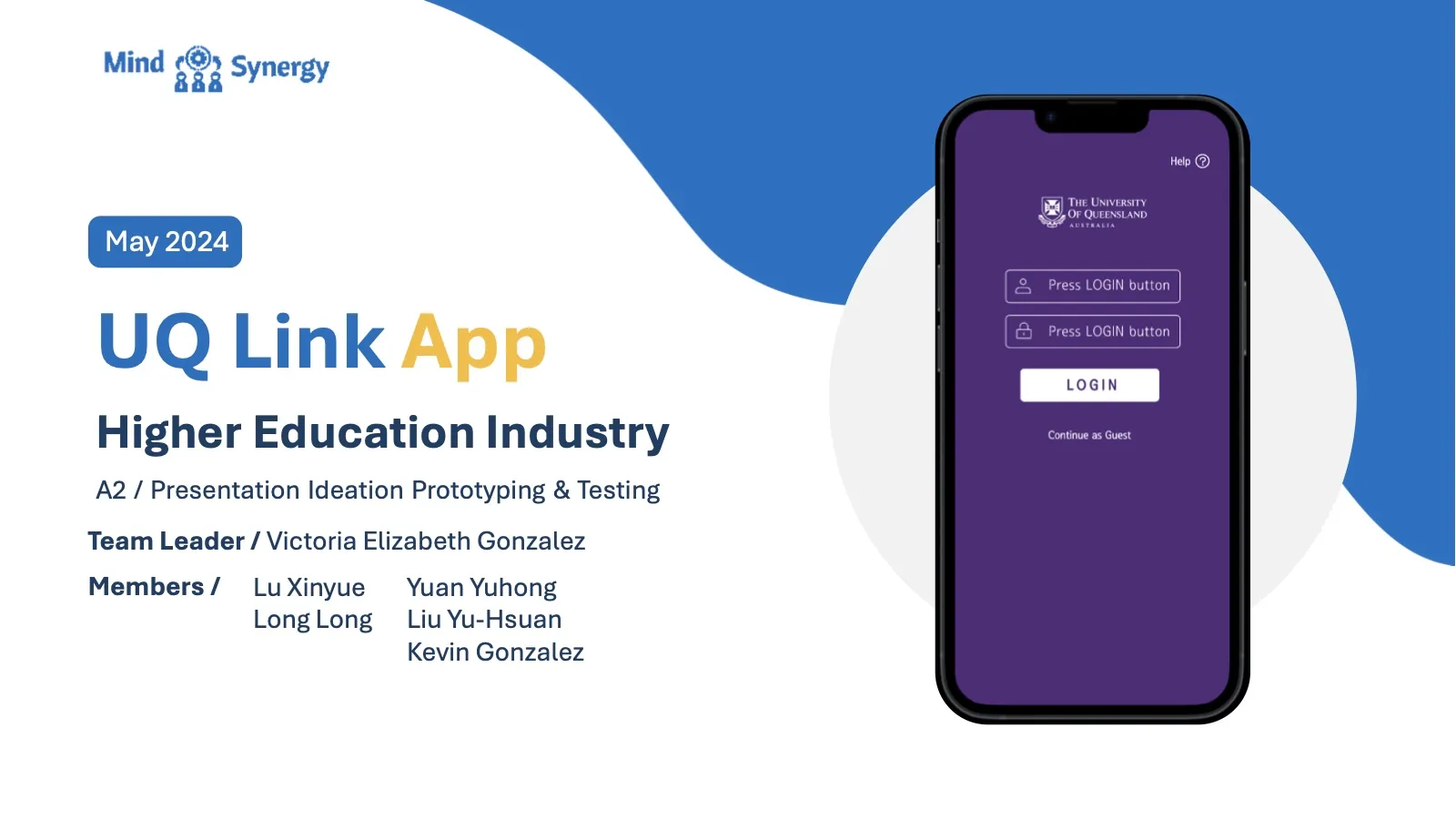
在昆士蘭大學修習 Creativity for Innovation and Design Thinking 時,我們以高等教育產業為題,用設計思考走完同理、定義、發想、原型與測試的完整流程。研究發現,UQ 的校園資訊散落在數十個網站與系統之間,龐雜的資訊與程序對國際學生特別不友善。因此我們提出 UQ Link App,一個把所有校園資訊整合在同一處的一站式平台,並以 Figma 製作可互動的原型,同時驗證它的商業可行性。
In UQ’s Creativity for Innovation and Design Thinking course, our team took on the higher-education industry and worked through the full design-thinking cycle: empathise, define, ideate, prototype and test.Our research showed that UQ’s campus information is scattered across dozens of websites and systems, and the sheer volume of information and procedures is especially unfriendly to international students.We proposed UQ Link App — a one-stop platform that brings all campus information into one place — built an interactive prototype in Figma, and tested its economic viability.
設計問題Design problem
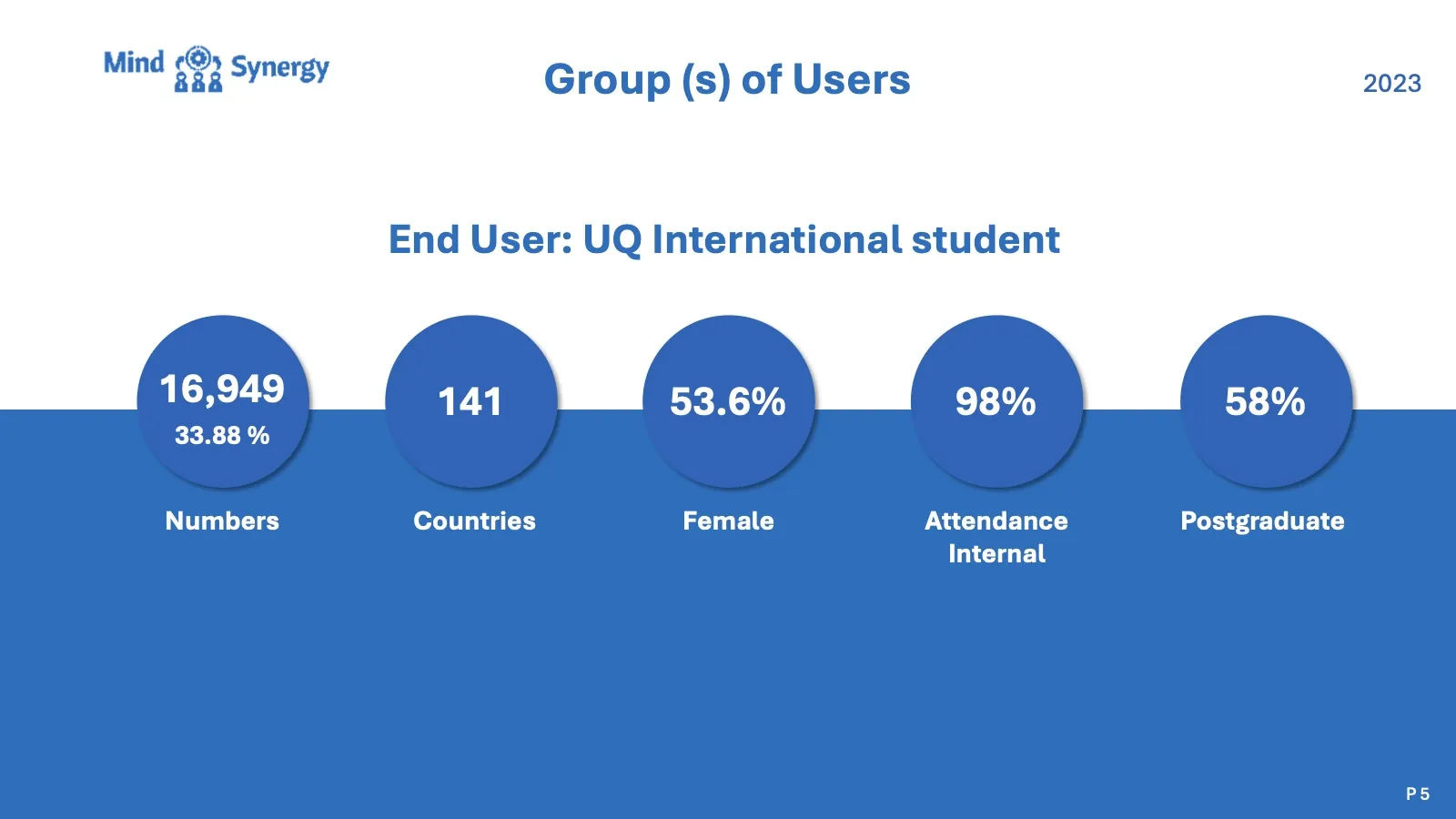
2023 年,UQ 有 16,949 位國際學生,佔全校 33.88%,來自 141 個國家,其中 58% 是研究生。他們初到澳洲,要在陌生的語言和制度裡,自己找出選課、作業、獎學金、住宿、醫療、安全與活動等資訊。
In 2023, UQ had 16,949 international students — 33.88% of the student body — from 141 countries, 58% of them postgraduates.Newly arrived in Australia, they have to find information on enrolment, assessments, scholarships, housing, health care, safety and events on their own, in an unfamiliar language and system.
同理:研究方法Empathise: research methods
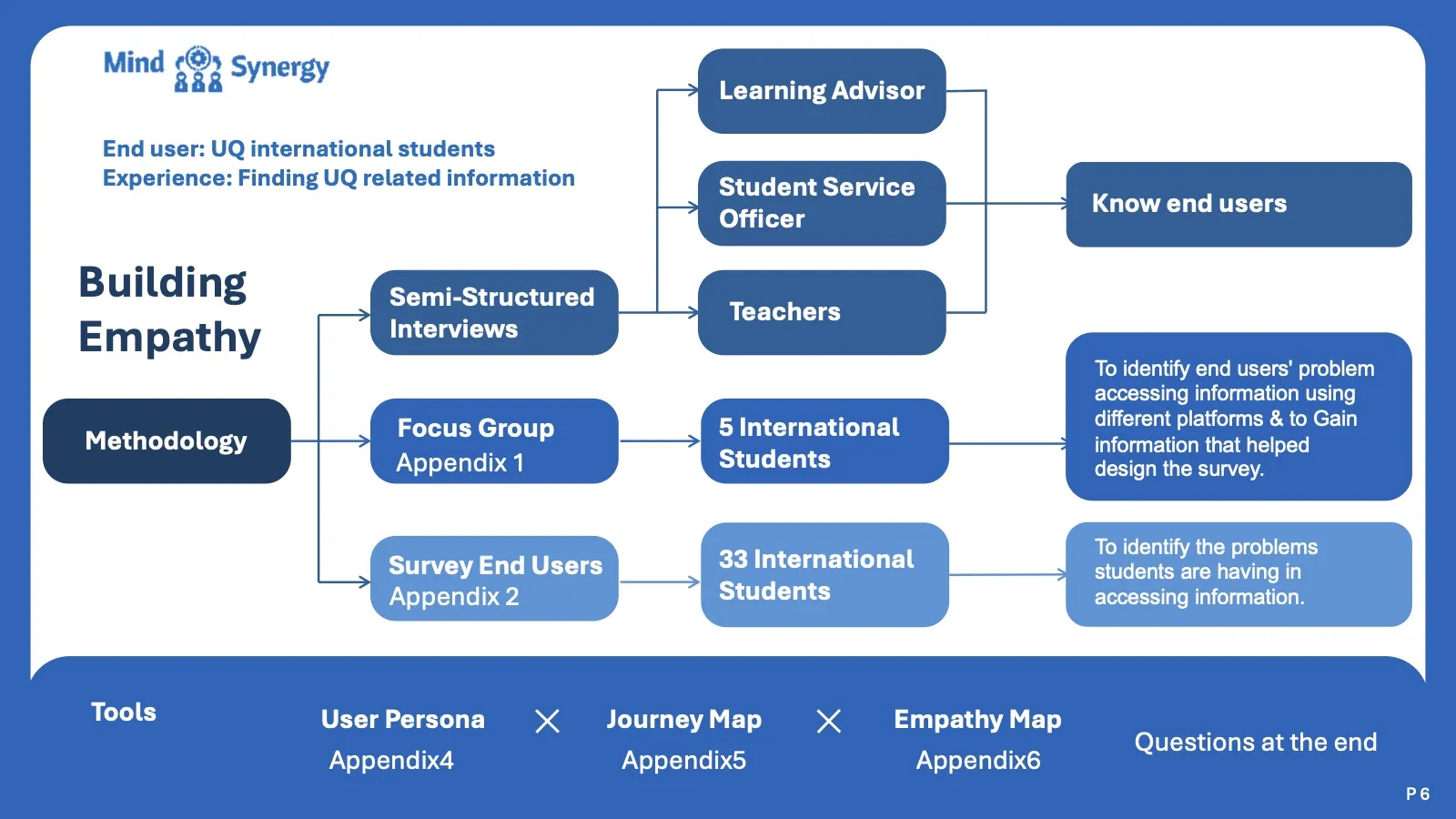
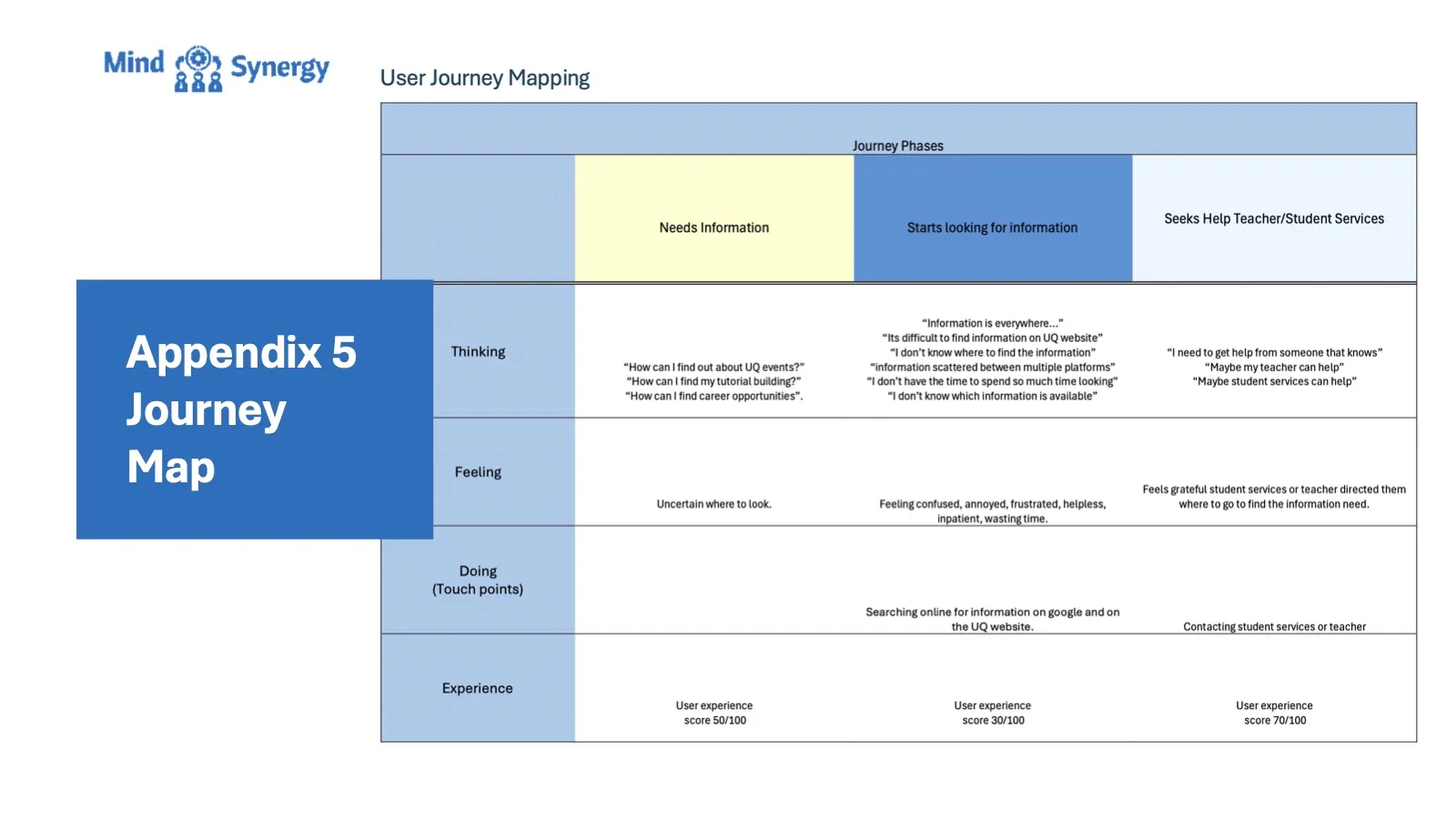
我們的終端使用者是 UQ 國際學生,聚焦的經驗是「尋找 UQ 相關資訊」。研究分成三種方法:與 5 位國際學生進行焦點團體,了解他們在不同平台找資訊時遇到的問題,並以此設計問卷;對 33 位國際學生發放問卷,確認問題的普遍程度;再半結構訪談教師、學生服務專員與學習顧問,從服務提供者的角度補足全貌。最後整理成人物誌、旅程地圖與同理心地圖。
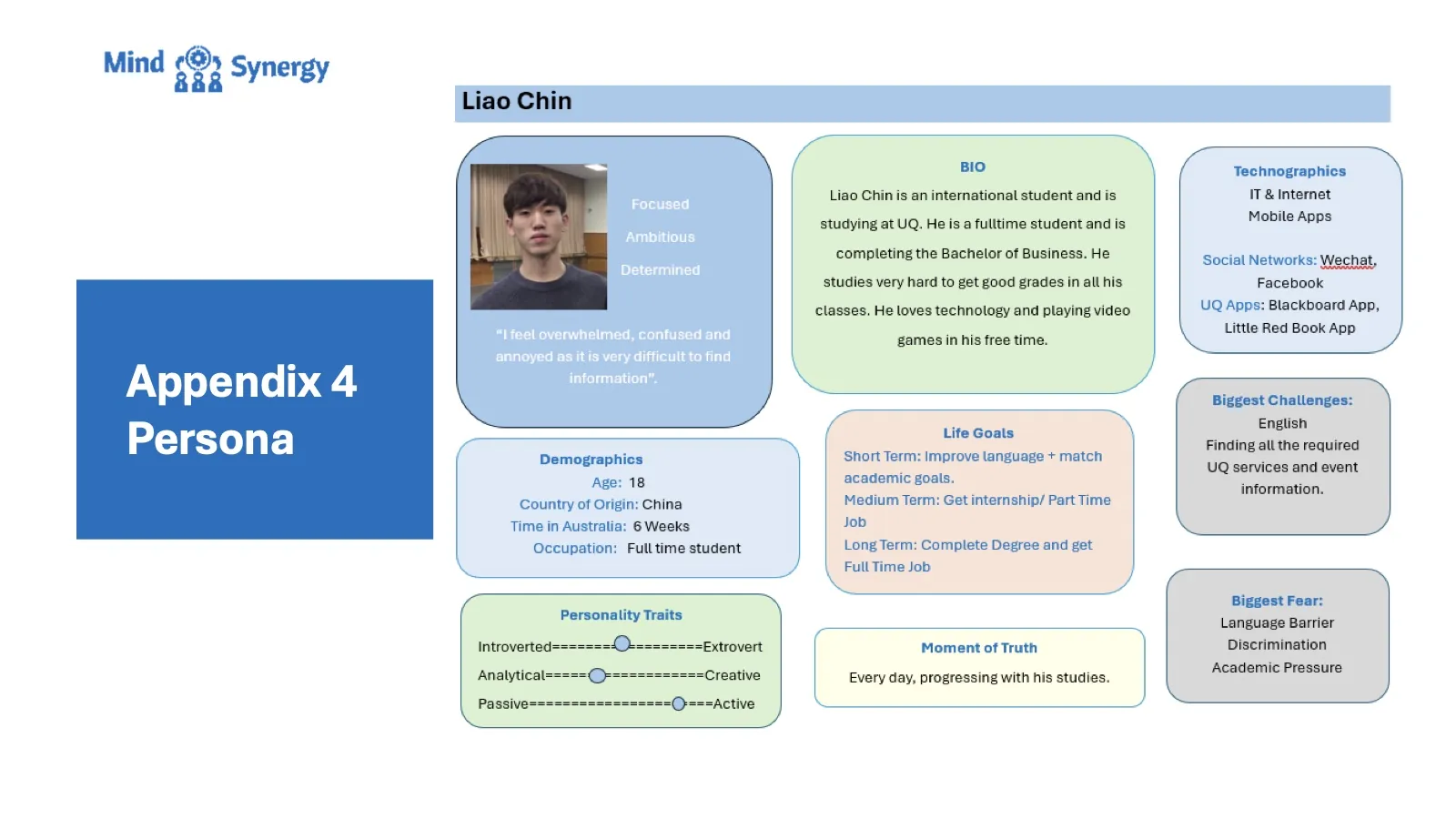
Our end users were UQ international students, and the experience we focused on was “finding UQ-related information.” We used three methods: a focus group with 5 international students to learn what goes wrong when they search across platforms, which then shaped our survey; a survey of 33 international students to gauge how widespread the problems were; and semi-structured interviews with teachers, a student service officer and a learning advisor to see the picture from the service side.We synthesised the results into a persona, a journey map and an empathy map.
定義:關鍵發現Define: key findings
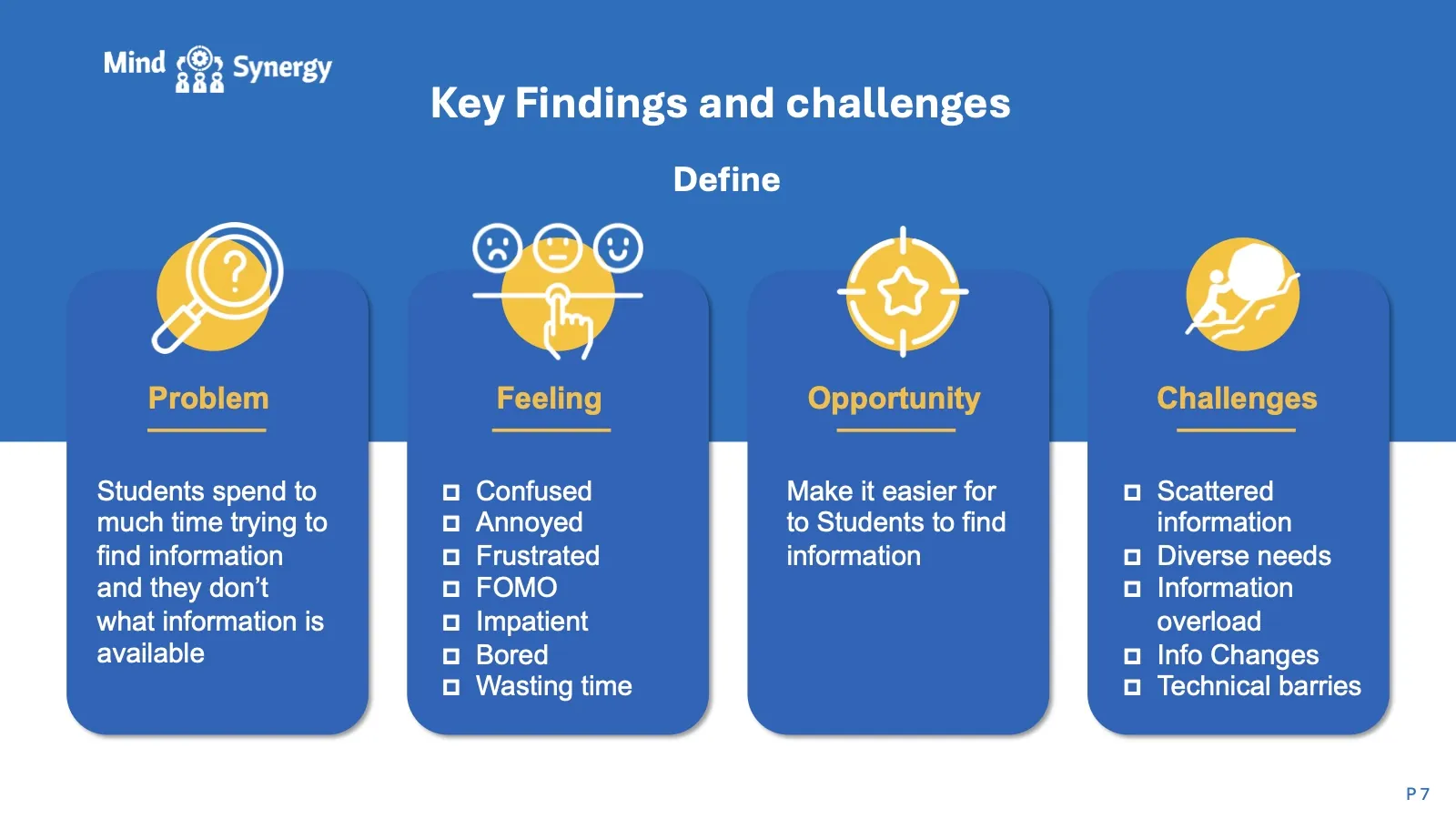
學生花太多時間找資訊,而且常常不知道有哪些資訊存在。找資訊的過程讓他們感到困惑、煩躁、挫折,也害怕錯過重要機會。背後的挑戰包括:資訊散落、需求多元、資訊過載、資訊經常變動,以及技術門檻。
Students spend too much time looking for information, and often don’t know what information exists at all. The search leaves them confused, annoyed, frustrated and afraid of missing out.The challenges behind it: scattered information, diverse needs, information overload, frequently changing information and technical barriers.
設計 POVDesign POV
我們的價值主張是:改變 UQ 學生取得與運用資訊的方式,讓它更有效率、更有生產力,也更愉快。
Our value proposition: transform how UQ students access and use information, making it more efficient, productive and enjoyable.
發想:一站式平台Ideate: a one-stop shop
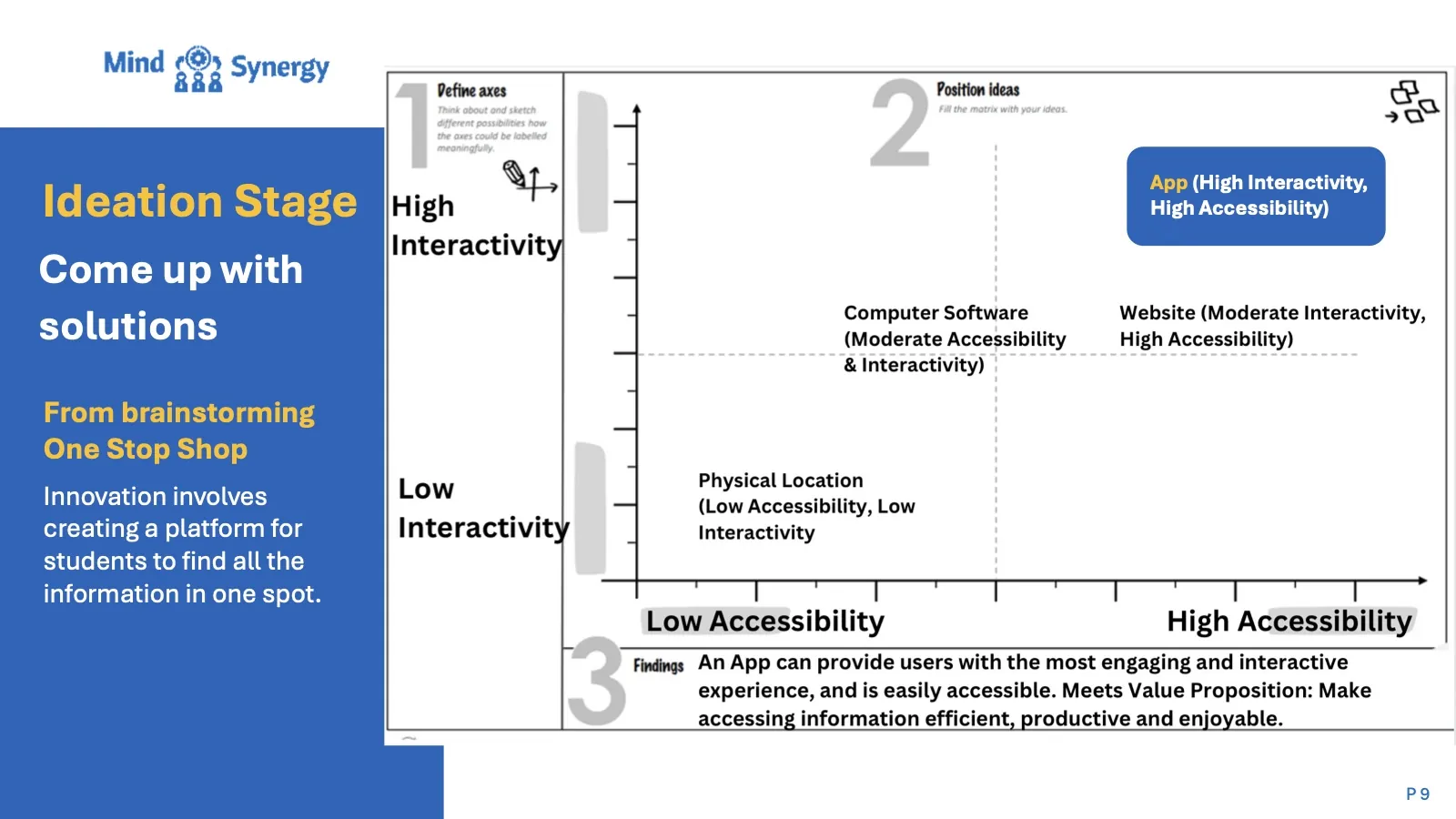
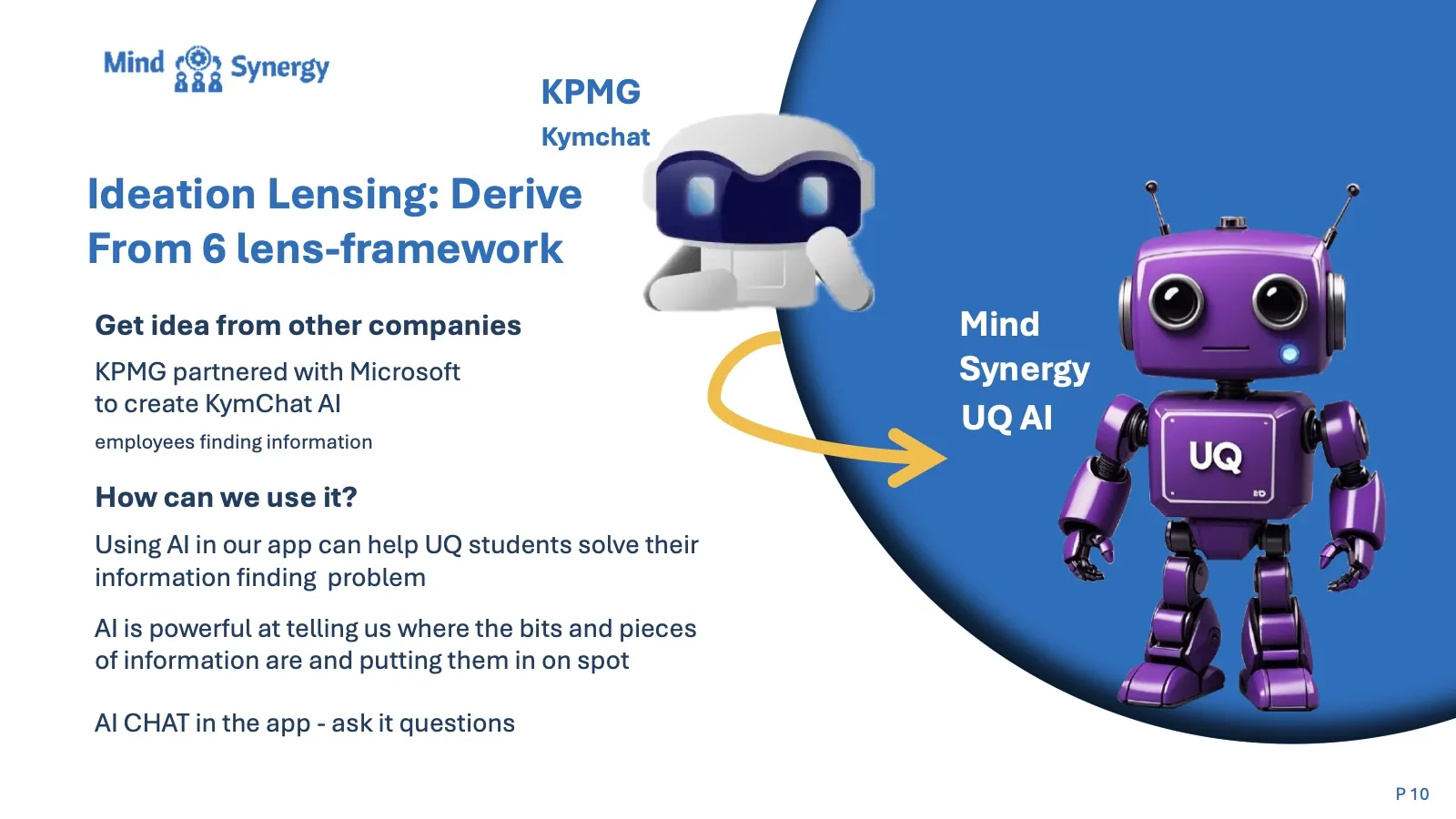
腦力激盪後,我們以「互動性」與「可及性」兩個軸度比較各種解法,選擇互動性與可及性都最高的 App,打造讓學生在同一處找到所有資訊的一站式平台。接著運用六透鏡框架,向其他產業借鏡:KPMG 與 Microsoft 合作開發 KymChat,幫員工在龐大資料中找到資訊。AI 擅長告訴我們零散的資訊在哪裡,並把它們整合在一起,所以我們在 App 中加入能直接提問的 AI 對話。
After brainstorming, we compared solutions on two axes — interactivity and accessibility — and chose an app, the option highest on both, to build a one-stop shop where students find everything in one place.We then used the six-lens framework to borrow from other industries: KPMG partnered with Microsoft on KymChat to help employees find information in vast internal data.AI is good at telling us where scattered pieces of information are and bringing them together, so we added an AI chat to the app that students can simply ask.
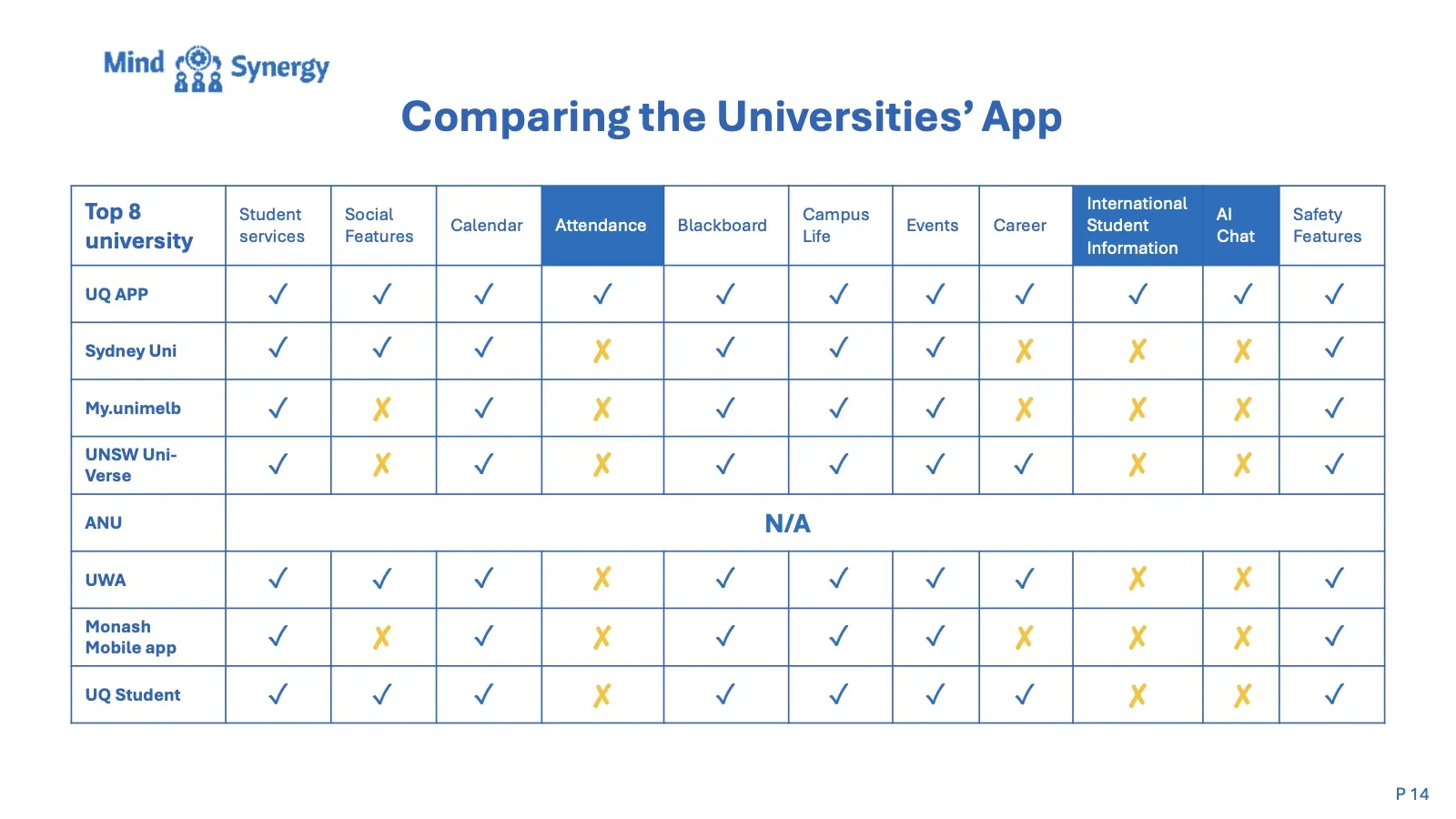
我們也盤點了 8 款澳洲頂尖大學的 App,比較學生服務、社群、行事曆、出缺勤、Blackboard、校園生活、活動、職涯、國際學生資訊、AI 對話與安全功能等 11 項功能。結果顯示,沒有一款同時具備國際學生資訊與 AI 對話,這正是 UQ Link App 的切入點。
We also benchmarked the apps of 8 leading Australian universities across 11 features: student services, social features, calendar, attendance, Blackboard, campus life, events, careers, international student information, AI chat and safety.None offered both international student information and AI chat — the gap UQ Link App was designed to fill.
原型Prototype
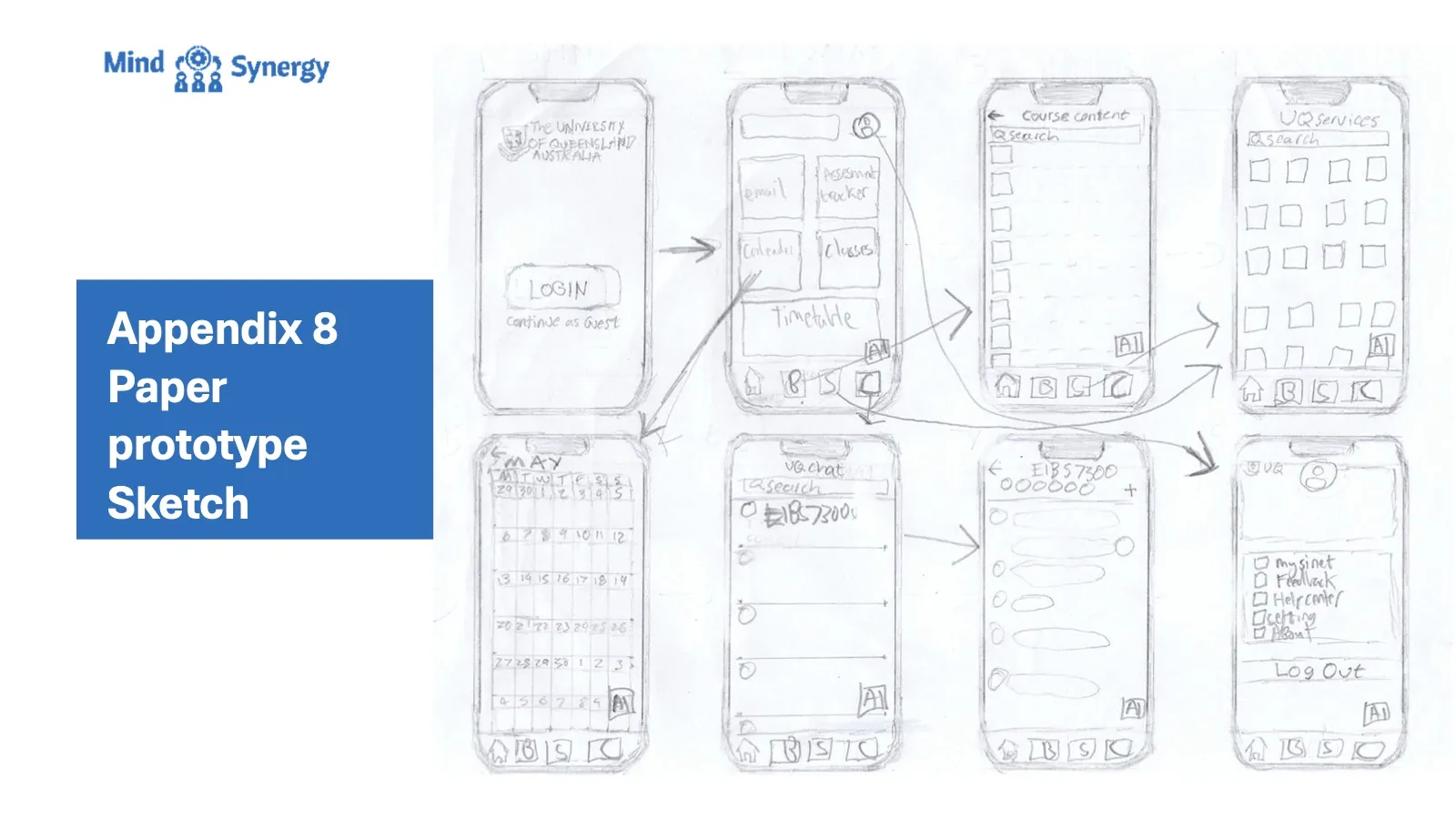
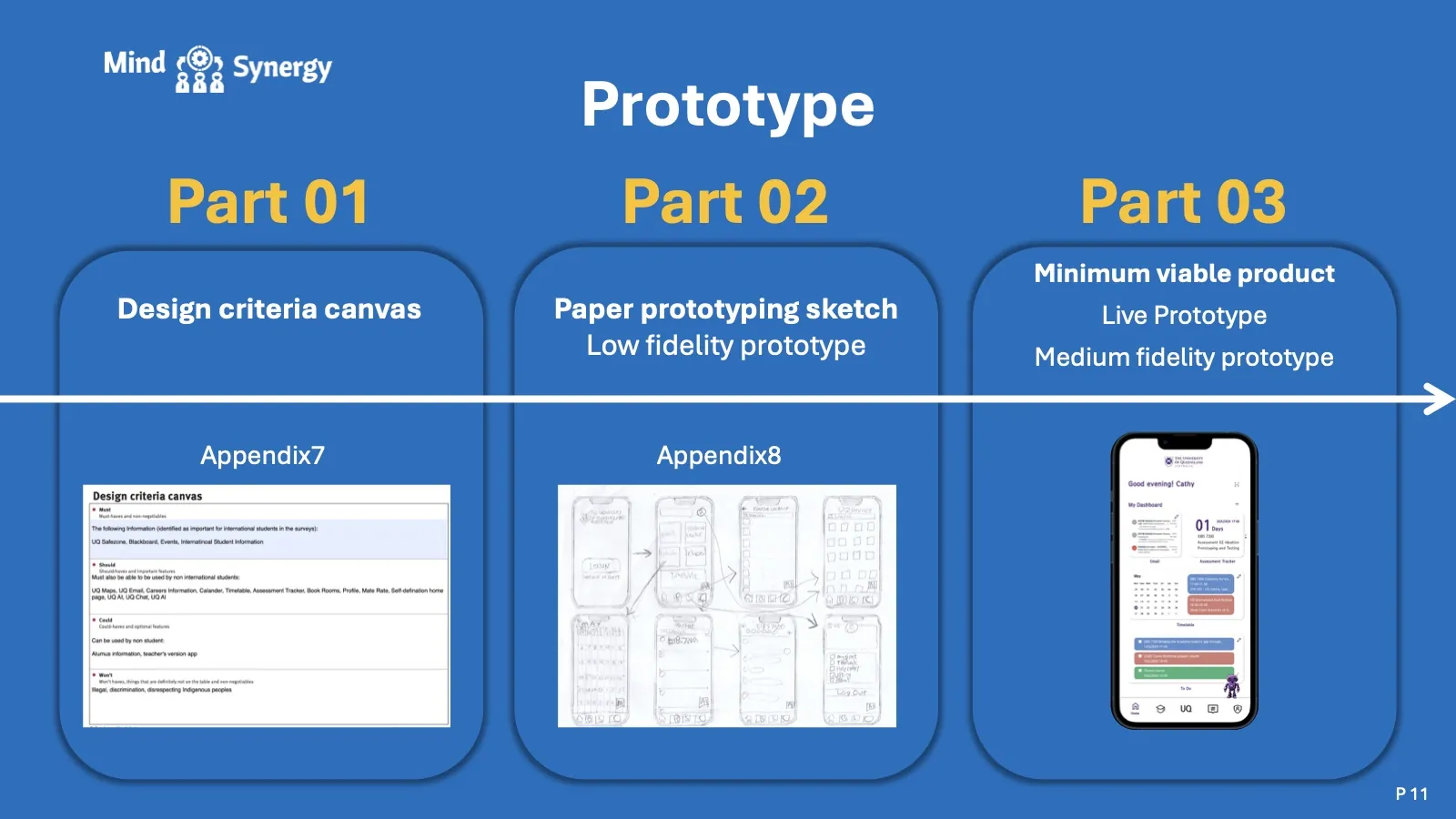
原型分三階段:先用設計準則畫布(Design Criteria Canvas)定義必須有、應該有、可以有與不會做的功能;再畫紙本原型草圖,確認資訊架構;最後以 Figma 做出中擬真度的最小可行產品。首頁是可自訂的個人儀表板,把電子郵件、作業倒數、課表與待辦事項放在同一個畫面,再搭配 UQ 服務總覽與 AI 對話。
We prototyped in three stages: a Design Criteria Canvas to define must-have, should-have, could-have and won’t-have features; paper sketches to settle the information architecture; and a medium-fidelity minimum viable product in Figma.The home screen is a customisable personal dashboard that puts email, assessment countdowns, the timetable and to-dos on one screen, alongside a UQ services overview and the AI chat.
測試Testing
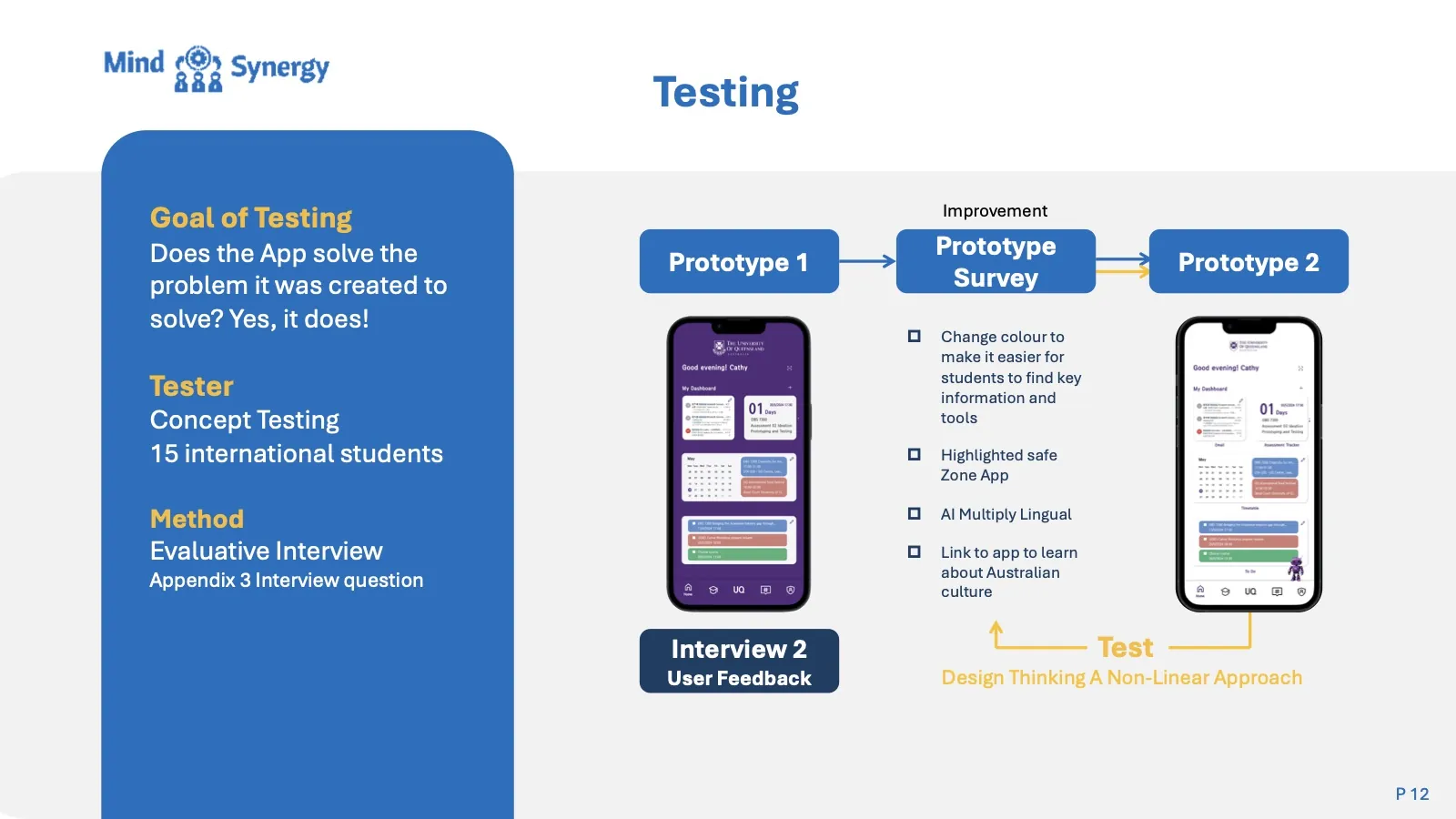
測試的目標只有一個:這個 App 有沒有解決它原本要解決的問題?我們邀請 15 位國際學生進行概念測試與評估式訪談,答案是肯定的。根據回饋,我們把第一版原型改成第二版:
The goal of testing was simple: does the app solve the problem it was created to solve? We ran concept tests and evaluative interviews with 15 international students, and the answer was yes.Based on their feedback, we revised prototype 1 into prototype 2:
- 調整配色,讓學生更容易找到關鍵資訊與工具
- 突顯校園安全 App SafeZone
- AI 對話支援多種語言
- 連結認識澳洲文化的資源
- Changed the colours so students can find key information and tools more easily
- Highlighted SafeZone, the campus safety app
- Made the AI chat multilingual
- Linked to resources for learning about Australian culture
商業可行性Economic viability
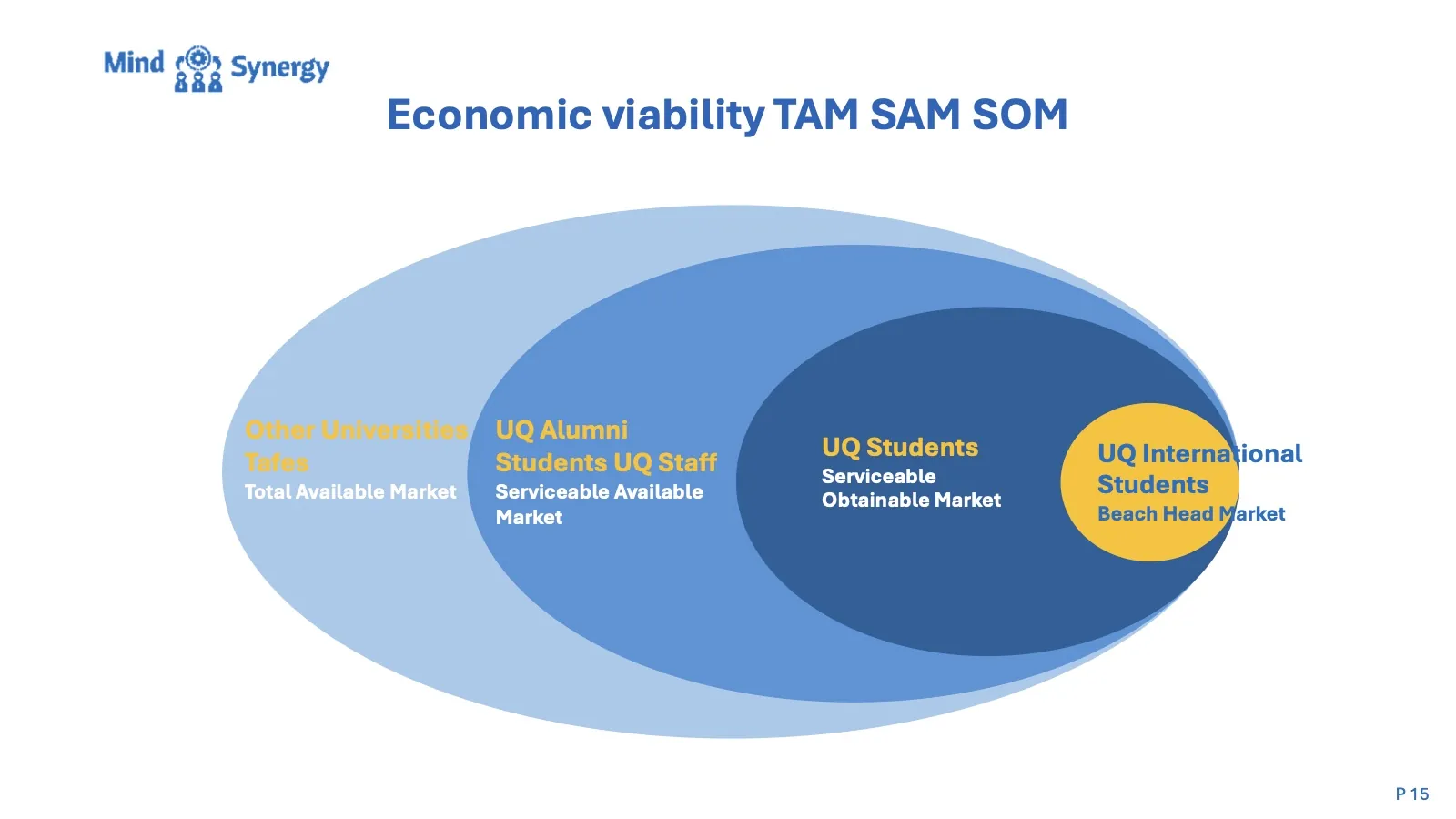
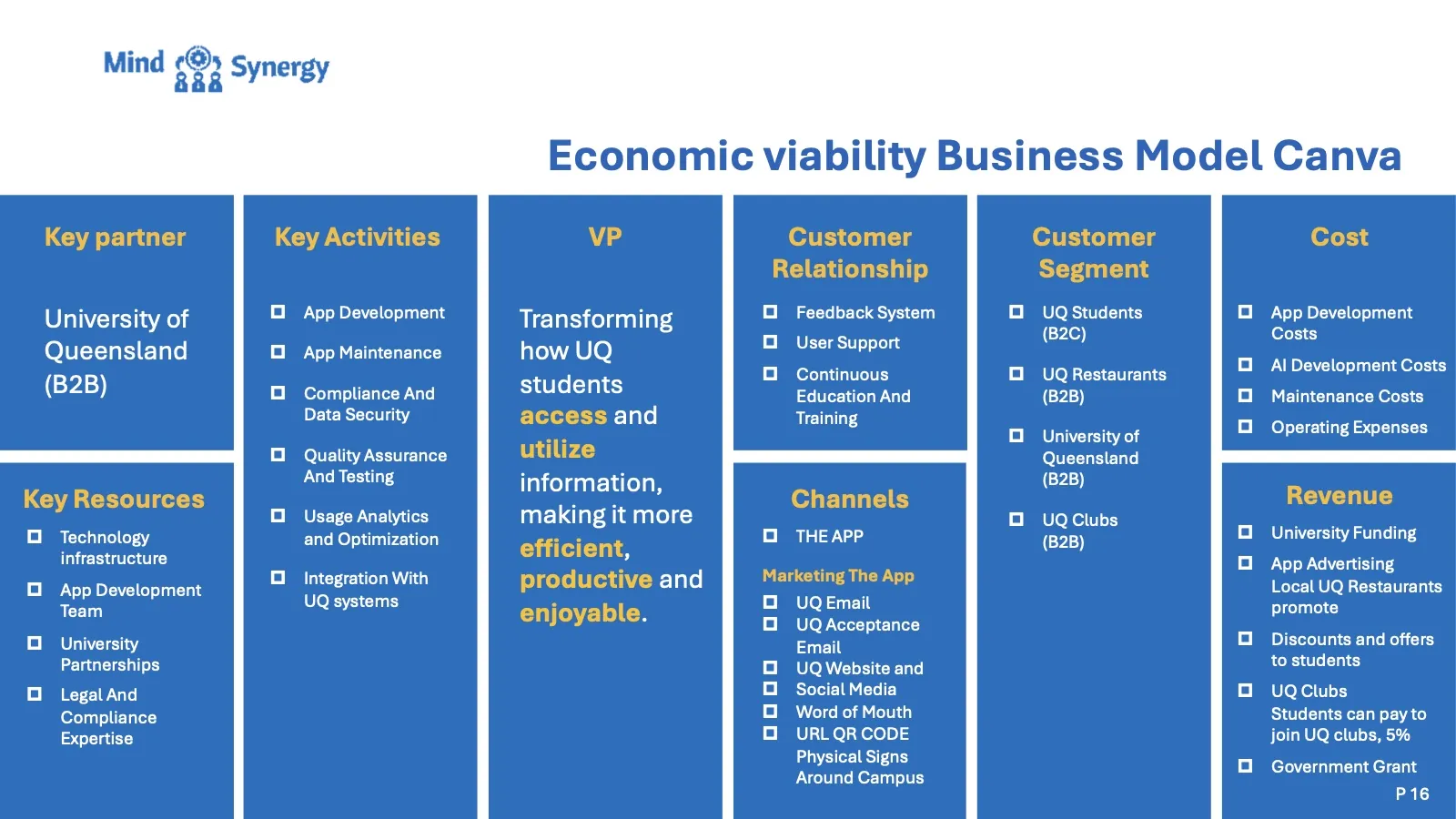
我們用 TAM、SAM、SOM 估算市場:從 UQ 國際學生切入,SOM 是全體 UQ 學生,SAM 擴及 UQ 校友與教職員,TAM 則是其他大學與 TAFE。商業模式採 B2B:由 UQ 為每位使用 App 的學生支付每年 8 澳幣,再加上校內餐廳廣告、社團入會抽成與政府補助。這個計畫也呼應昆士蘭政府的《數位服務計畫 2024–2028》與 2 億澳幣的數位經濟策略。
We sized the market with TAM, SAM and SOM: starting with UQ international students, the SOM is all UQ students, the SAM extends to UQ alumni and staff, and the TAM covers other universities and TAFEs.The business model is B2B: UQ pays AUD 8 a year for each student who uses the app, supplemented by on-campus restaurant advertising, a share of club memberships and government grants.The project also aligns with the Queensland Government’s Digital Services Plan 2024–2028 and its AUD 200 million digital economy strategy.
- 開發成本約 18.5 萬澳幣:App 12.5 萬、AI 功能 6 萬,約 4–6 個月完成
- 以 UQ 學生人數推估使用率,第一年小幅虧損,第二年起轉虧為盈,淨利率 32%,第五年達 67%
- 損益兩平只需約 19–33% 的學生使用
- Development cost of about AUD 185,000 — AUD 125,000 for the app and AUD 60,000 for AI — over 4–6 months
- Projecting adoption from UQ enrolments: a small loss in year one, profit from year two at a 32% net margin, rising to 67% by year five
- Break-even requires only about 19–33% of students to use the app
反思Reflection
期末發表後,老師給了我們三個回饋。我對它們有同意、也有不同意,這成為我反思的起點:
After our final presentation, the lecturer gave us three pieces of feedback. I agreed with some and not others — and that became the starting point for my reflection:
- 聚焦在地化(我不同意):老師建議做出 UQ 的在地特色,與其他大學區隔。但我們的 TAM 本來就是全澳大學與 TAFE,而 UQ Link App 的功能已涵蓋其他大學 App 的功能。借鏡台灣的 TronClass,一套平台就能服務許多學校,與其在地化,不如成為可以擴散的通用平台。
- 別讓解法限制想像(我同意):「一站式平台」太早框住了點子。國際學生其實也想認識澳洲文化,這可能需要實體的解法。應先用 Crazy 8 發散,而我認為答案是線上與線下整合。
- 更廣的應用(我同意):從財務角度看,只服務國際學生的市場不足以支撐營運,App 應該擴及所有學生。
- Focus on localisation (I disagreed): the lecturer suggested building UQ-specific features to stand apart from other universities.But our TAM was every university and TAFE in Australia, and UQ Link App already covers the features of other universities’ apps.Like Taiwan’s TronClass, one platform can serve many schools — so rather than localising, it should become a platform that scales.
- Don’t let the solution limit the idea (I agreed): “one-stop shop” boxed in our ideas too early. International students also want to understand Australian culture, which may call for a physical solution.We should have diverged first with Crazy 8s — and I believe the answer is to integrate online and offline.
- Broader applications (I agreed): financially, a market of international students alone isn’t big enough to sustain the business, so the app should serve all students.
團隊也遇到兩個挑戰。第一是重新框架問題:我們的問卷帶有引導性,因為我們希望受訪者說「好」。朋友會說謊,但行為不會,更好的做法是把原型放上網站,用實際使用數據來驗證。第二是商業模式:誰會付錢、為什麼付錢?我認為可以採取由下而上的策略,先組成學生團隊取得正當性,再透過 UQ 學生與教職員夥伴計畫和政府數位服務計畫爭取資源,最後向學校提案。
The team also faced two challenges. The first was reframing the problem: our survey asked leading questions because we wanted people to say yes.Friends lie, but behaviour doesn’t — a better test would be to put the prototype on a website and let real usage data speak. The second was the business model: who pays, and why?I proposed a bottom-up strategy — form a student team to gain legitimacy, tap the UQ Student-Staff Partnership program and the government’s Digital Services Plan for resources, and then pitch to the university.
課程團隊Course team
課程|Creativity for Innovation and Design Thinking
Course | Creativity for Innovation and Design Thinking
團隊|Yu-Hsuan Liu, Victoria Elizabeth Gonzalez, Lu Xinyue, Long Long, Yuan Yuhong, Kevin Gonzalez
Team | Yu-Hsuan Liu, Victoria Elizabeth Gonzalez, Lu Xinyue, Long Long, Yuan Yuhong, Kevin Gonzalez